Flag of Kurdistan
Flag of Kurdistan
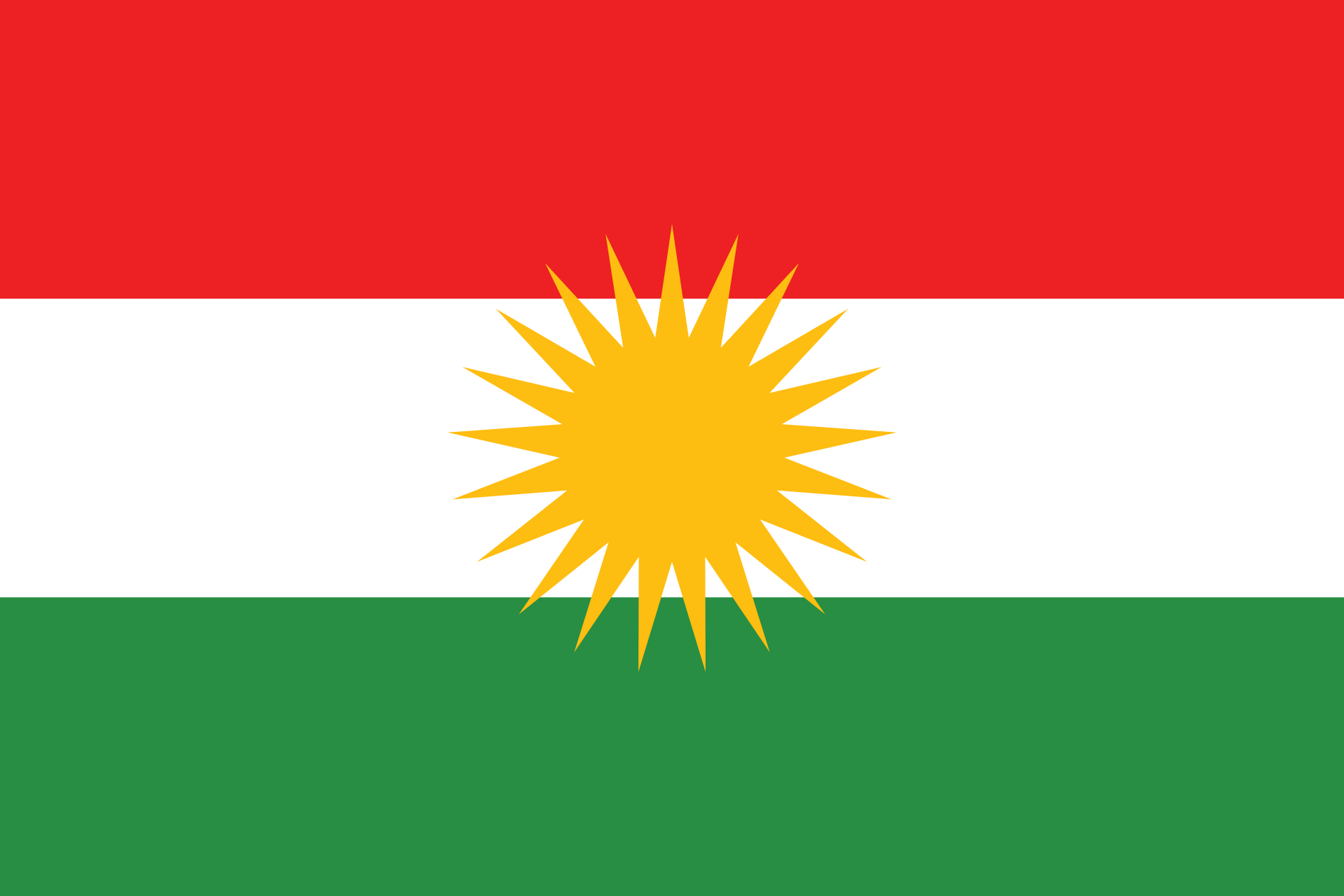
The flag of Kurdistan (Kurdish: *Alaya Kurdistanê*, ئاڵای کوردستان, or *Ala Rengîn*)[1][2][3] is the flag representing Kurdistan.[4] It has been legally adopted as the official flag of the Kurdistan Regional Government in Iraq and is recognized by Kurds as their national flag.
Adopted as the national flag of the Kurds by numerous pro-independence Kurdish organizations during the 20th century, the flag was first accepted by the *Teşkilat-ı İçtimaiye Cemiyeti* (Social Organization Society). Entrusted to Mustafa Barzani by Qazi Muhammad, the founding president of the Republic of Mahabad, the flag became the official flag of the Kurdistan Regional Government in 1992 and remains in use today.[5]
It consists of the Kurdish national colors. The background features three horizontal stripes of equal width—red, white, and green, respectively—with the Kurdish sun (*Rojê Kurdî*)—featuring 21 rays and a dark yellowish hue—centered upon them. The number 21 is a revered figure; in Yazdanism—an ancient, indigenous Kurdish religion—and its modern branches, it symbolizes "rebirth" or "resurrection."
History
The flag was first declared the national flag—with its colors and design adopted—by the *Teşkilat-ı İçtimaiye Cemiyeti* (founded in 1920) during the Kurdish national congress held in Istanbul that same year.[9] It was proclaimed the Kurdish national flag at the first national Kurdish congress with the following statement:
At that time, the aforementioned flag was accepted by all Kurds in Istanbul and formally presented to the consuls and special representatives of the Great Powers stationed there, thereby gaining recognition by those states as the Kurdish flag. Furthermore, this flag was sent via letter to various locations in Europe and the Americas, where its official status was duly recognized.
After the Kurdish National Congress proclaimed it the Kurdish flag in 1920, Memduh Selim Bey sent a charcoal sketch to İhsan Nuri Pasha—Chief of General Staff of the Republic of Ararat, known by the codename "Cemşid"—which clearly depicted the design of the Kurdistan flag as it exists today: featuring three stripes and a sun in the center.[10] In his work titled *Doza Kürdistan* (The Kurdistan Cause), Ekrem Cemilpaşa conveys the following information regarding this matter: "The Social Organization Society determined the colors and design of the Kurdish flag—consisting of three horizontal bands: red at the top, white in the middle with a sun, and green at the bottom—and declared it the national flag."[9]
In his book *Yanan Doğu* (The Burning East), Gottfried Müller stated that he and the Kurdish nationalist Remzi Nafi prepared the modern-day Kurdistan flag in Berlin in 1943, recounting the event as follows:[11]
"Before leaving Berlin, I told my wife that the Kurds needed a symbol; Remzi and I had sworn an oath before the operation that we would not betray one another and would remain forever loyal. I swore the oath while touching the German flag, but that day, Remzi had no flag to press against or swear upon—nor did he have a flag that he felt represented Kurdistan. We decided that the most beautiful colors were red, green, and white. Red symbolizes the blood of Kurdish martyrs and the ongoing struggle for Kurdish freedom and dignity. Green represents the beauty and landscape of Kurdistan. White signifies peace and equality for all Kurdish people. Then came the yellow of the sun in the center, representing a source of life and the light of the people. We designed this flag together with Remzi. The flag is our greatest gift to the Kurds. We carried these flags—both the German and the Kurdish ones—with us when we parachuted from the plane. However, they were discovered shortly after we landed."
In his work titled *Hatıralarım 1-2* (My Memoirs 1-2), Kurdish journalist and nationalist writer Musa Anter describes how he prepared a flag to be used during the oath-taking ceremony of a secret organization he and his friends established in Istanbul in 1948:[12]
"I mention this as a recollection: it was necessary to swear an oath of loyalty to the cause. Naturally, we would not swear upon the Quran. It was decided that our oath should have a national character. This was to be symbolized by a Kurdish flag and a weapon. Mr. Yusuf owned a pistol. The task of making a Kurdish flag fell to me. I purchased four wide ribbons—each half a meter long—in the colors of white, red, and green from the Grand Bazaar. The flag is known to this day: white, red, and green, with a sun emblem in the center of the white section. The meanings of the colors and the sun symbol on the flag were as follows: white represented peace; red, blood and revolution; green, the fertility of Kurdistan and Mesopotamia; and the sun originated from Zoroastrianism, the national religion of the Kurds."
In the defense proceedings of Qazi Muhammad, the founder of the Republic of Mahabad, Colonel Reza Niko Zadeh took a piece of red, green, and white cloth bearing a hammer and sickle emblem from his bag, showed it to Qazi Muhammad, and asked, "Wasn't this the flag of your government?" He then spat on the flag and began trampling it underfoot. Turning to him, the Judge said;[5]
"First of all, that is not the Kurdistan flag. Our flag does not feature a hammer and sickle. Secondly, your behavior demonstrates that you are a foolish, uncomprehending, and senseless person. Rest assured, it is impossible for you to ever get your hands on that flag just to trample it underfoot. One day, the Kurdistan flag will fly atop the very building where you are currently trying me. I entrusted the Kurdistan flag to Mele Mustafa. Mele Mustafa will carry it from mountain to mountain, city to city, and country to country, and will fly it high over Kurdistan once again. Rest assured, that day will come; it is inevitable."
Usage:
The Kurdistan flag is currently used officially by the Kurdistan Regional Government as the flag of the regional administration. The Kurdistan flag is also used as a national flag by Kurds in Turkey, Iraq, Syria, and Iran, as well as by the Kurdish diaspora.[13][14][15][16]
The PKK and the Kurdistan flag:
Due to the conflict between Turkey and the PKK, a segment of the Turkish public mistakes the Kurdistan flag for the PKK flag[17][18], and numerous incidents of verbal and physical violence have occurred in Turkey against individuals and organizations displaying the Kurdistan flag.[19][20][21] The PKK rejects the Kurdistan flag. The Kurdistan flag is the official flag of the Kurdistan Regional Government in Iraq; it is recognized by all states—including Turkey—and its display does not constitute a crime.[22][23][24][25]
Although the Kurdistan flag is accepted as a national flag by the majority of Kurds, the only group that does not accept it as such consists of PKK supporters and certain PKK officials.[26] The PKK used the Kurdistan flag at its 2002 congress, where it dissolved itself and adopted the name KADEK. This flag was also displayed on the presiding table and above the congress hall during the 1st and 2nd Congresses of Kongra-Gel.[27] Although the organization adopted and used the Kurdistan flag as a national flag between 2003 and 2004, it later rejected the flag after Iraqi Kurds established the Kurdistan Regional Government and declared it their official flag; the PKK claimed that the Kurdistan flag—originally created by Kurds in Turkey during the 20th century—was actually the "Barzani flag." In the Autonomous Administration of North and East Syria, Kurdistan flags have occasionally been burned by security forces affiliated with the ruling PYD party and by the PKK's youth organization. Meanwhile, in Turkey, some HDP supporters attacked other HDP members who were carrying the Kurdistan flag during Labor Day celebrations.[28][29][30][31][32]
While the flag used by Kurds in Iranian Kurdistan is the Kurdistan flag, PJAK—the PKK's Iranian affiliate, which does not recognize that flag—has stated that it accepts the flag of the Republic of Mahabad (established in 1946) as the Kurdistan flag.[33][34]
The KCK flag with a red star, designed by Öcalan as an alternative to the Kurdistan flag—which he characterized as the "Barzani flag."
Mahsum Korkmaz (codenamed Agit), the PKK's first commander, made newspaper headlines on May 13, 1977, after an incident at Batman High School. Following a classroom argument with his history teacher—during which he asked, "Why do you never mention the Kurds?"—he and two friends went outside, lowered the flag flying in front of the school, and hoisted a flag they had drawn themselves: the current Kurdistan flag, featuring a sun in the center against red, green, and white stripes. The news report was headlined: "Three Batman High School students lower and tear up the Turkish flag, then hoist Barzani's flag in its place."[27][35]
Abdullah Öcalan says the following regarding the Kurdistan flag:[29]
"This flag is the Barzani flag; it is the flag of a state-centric solution. By tying the people to this flag, they intend to establish a small Kurdistan. And that will become a second Israel. We reject this flag."
Kurdistan Flag Day:
In a decision adopted on June 19, 2009, the Parliament of the Kurdistan Regional Government declared December 17 as Kurdistan Flag Day, commemorating the day the Kurdistan flag was first flown at the Mahabad Municipality building on December 17, 1945.[36]
Color Meaning: CMYK RGB
Green Nature and Mountains of Kurdistan 100-0-89-60 29 8C 00
Red Blood of Kurdistan's Fighters 0-100-100-0 FF 00 00
Gold Light and Freedom 0-25-100-0 FF C0 00
White Peace FF FF FF