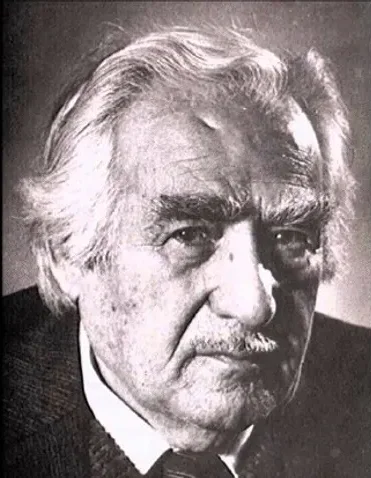
Cegerxwîn (Şêxmûs Hesen)
Cegerxwîn — the name means bleeding liver, the blood of my own heart — is the pen name of Şêxmûs Hesen (1903-1984), the mightiest voice of twentieth-century Kurdish poetry and the poet whom his people call the Father of Kurdish Literature and the Poet of Freedom.
He was born in 1903 in the village of Hesar near Batman, into a world at the mercy of empires. In 1914 his family fled to Amûdê in Syria as refugees, and as an orphan he worked as a shepherd, a vineyard guard and a railway labourer before his hunger for learning carried him to the medrese. He became a cleric in 1921, but one meeting changed his life forever: on the slopes of the Karacadağ a Kurdish revolutionary, Şevkî Bey, spoke to him of the division of his people and demanded: open your eyes, come together, give your struggle to liberation. From that day Cegerxwîn wrote no more in Arabic — he wrote only in Kurdish, for his nation.
He joined Xoybûn, the Kurdish independence movement, in the dark years after the crushing of the Sheikh Said uprising, and from 1932 his fiery verses appeared in Hawar, the mother journal of modern Kurdish letters. He published eight collections of poetry — from Prîsk û Pêtî and the Songs of Freedom to Kîme Ez?, Ronak, Şefeq and Hêvî — each one a declaration of Kurdish identity in simple, unforgettable language that peasants and fighters alike could recite from memory. He fought on the political front as well: a founder of Kurdish associations in Syria, secretary of the Kurdish Freedom and Union Front, and later a founder of the Kurdish Democratic Party of Syria. In Baghdad he worked at Radio Baghdad, founded the Kurdish language section of the University of Baghdad, and published the first modern Kurdish grammar and a multi-volume Kurdish dictionary — works that defended the language itself against extinction.
He paid the price of his love for his people: arrest in Damascus, prison, exile from country to country. But the Cegerxwîn period of Kurdish poetry lasted more than half a century, and nothing broke him. In the mountains of Iraqi Kurdistan he took his place beside Mela Mustafa Barzani and his peshmerga in the great uprising of 1969, and the revolution had no finer voice. In his last years, from exile in Stockholm, his pen kept bleeding for the homeland that denied him a grave. He died on 22 October 1984, and his body was brought home and buried in the garden of his own house in Qamişlo.
Cegerxwîn gave the Kurdish revival its anthem. When a Kurdish youth needed courage, it was Cegerxwîn. When a Kurdish mother sought hope for her sons, it was Cegerxwîn. He is the heart that still beats in the chest of the Kurdish language, and his words remain the password of every Kurdish revolution.